Perception of Time: The Battle between the Present and Future Self

We eat too much, we drink too much, we skip that gym session..again, we procrastinate, we stay up into the wee hours. We humans are funny, aren't we?
We succumb to our cravings in the present moment even though we are well aware of its future consequences. How does the mind do that? How are we convincing ourselves over and over that a dopamine hit right now is worth sacrificing our physical and mental wellbeing in the future? We don't seem to learn and our future selves pay the price.
A Psychological Phenomenon
I was always fascinated by this phenomenon. While doing some research on the topic, I found that the underlying problem is the brains skewed perception of time. It's a psychological phenomenon called temporal discounting or time preference.
Wikipedia defines temporal discounting as follows:
Temporal discounting refers to the tendency of people to discount rewards as they approach a temporal horizon in the future or the past (i.e., become so distant in time that they cease to be valuable or to have additive effects).
Or in other words, the further in the future the consequences, the less we pay attention to them.
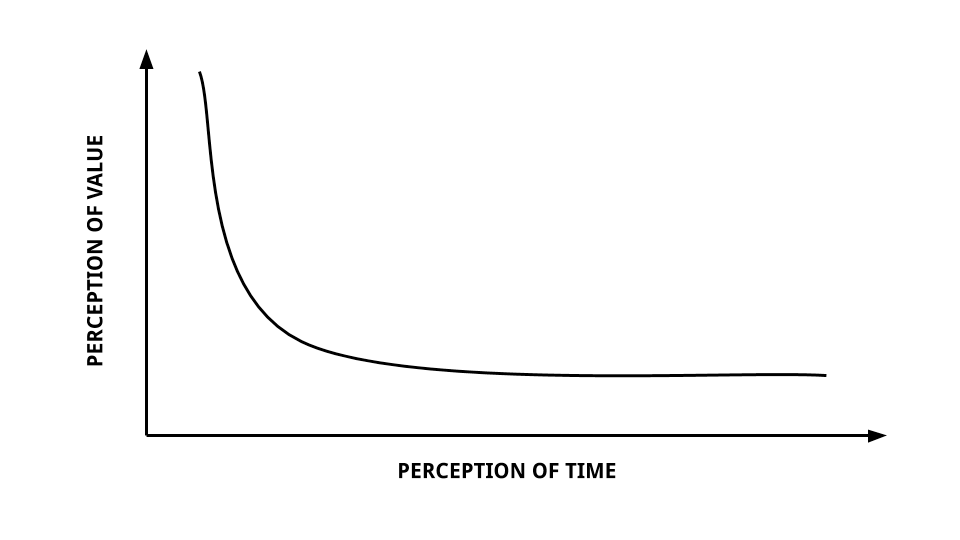
Temporal discounting is a survival mechanism that made absolute sense for most of human existence. The threat right in front of you is what's important and in order to live, you need to act right now. The issue is, in our more or less safe and cozy world this well-meant mechanism has a devastating, compounding effect on our lives. Each decision in the moment might seem small, but added up over time they become a huge deal. Good decisions lead to desirable outcomes, bad decisions to undesirable outcomes.
How to bring the future self into the picture
In her book Thinking in Bets, the successful poker player Anne Duke suggests the following:
“Bringing our future self into the decision gets us started thinking about the future consequences of those in-the-moment decisions.”
So how do we do that?
The psychological community recommends a mental exercise it calls 'visualizing regret':
Before making a decision, put yourself in the shoes of your future self. Make a real effort to visualise how your future self will feel about the decision of your present self, which will become your past self.
BUT, visualizing potential future regrets is not here to stop you from making a decision. It is merely a thought exercise to make your brain learn how decisions in the now may effect your future state. To me in fact, it's about training our own empathy toward our future self and escape the current momentum of wanting something at all costs.
A structured approach to empathise with your future self
Now, its really freaking difficult to bring up the mental energy to stop in the moment and properly visualize the feelings and thoughts of our future self. Luckily there is a method called the '10-10-10 approach to decision making' that was popularized by the famous investor Warren Buffett. It's actually really simple and works as follows.
When you are about to make a decision, big or small, ask yourself those three questions:
- How will I feel about my decision in 10 minutes?
- How will I feel about my decision in 10 months?
- How will I feel about my decision in 10 years?*
For smaller decisions its even more powerful if you account for the compounding effects of a decision: How would I feel about my decision in 10 months if I take this decision every day?
Even knowing about these exercises and doing them consistently won't ensure you are taking the "right" decision every time. But what it will do is to train your brain to let your future self join the conversation on what the "right" decision might be.